

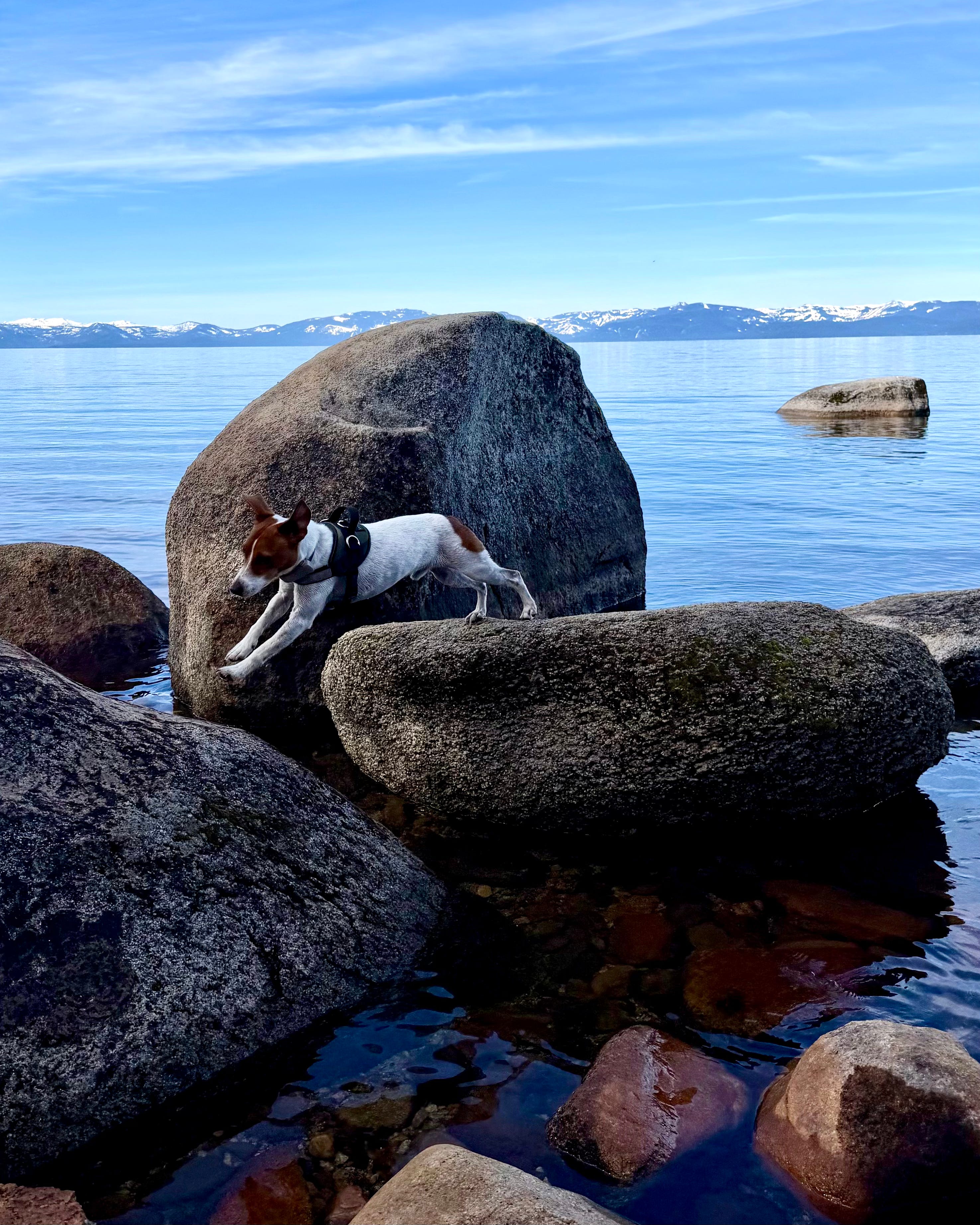
I stopped walking.
On the shore of Sand Harbor Sate Park, my feet sunk an inch in the wet sand as I looked southwest across the lake at the rocky peaks rising above the tree line.
My wife, Lynn, our Jack Russell Terrier, Archie, and I were on a Sunday morning walk in late March.
Across Lake Tahoe from where we stood, the high slopes held 30% of their normal snowpack, a brittle, white exoskeleton clinging to their rocky surfaces under a blue sky streaked with the long tails of a few cirrus clouds.
Mid-morning temperatures had already reached over 60º Fahrenheit on their way into the 70s.
Lynn let Archie off leash and we continued strolling.
The dog climbed over some granite boulders clustered a few feet offshore, then he made me feel weightless as Lynn and I watched him leap between the rocks.
She laughed.
The sun’s heat on my cheekbones grounded my quick flight, reminding me of how living here through this atypical warm, dry weather can ignite the Tahoe Basin’s wild core.
Wildfire is part of the Tahoe’s natural design.
A 2017 University of Nevada Cooperative Extension publication, Fire Adapted Communities, reports that frequent fires occurred around the lake for thousands of years.
Prior to European-American settlement, fires happened on average every five to 18 years, according to USDA Forest Service data, which the report cites.
These burns, often low-intensity, on the forest floor cleared out layers of dead pine needles, twigs and other growth creating an “open, park-like forest.”
Old trees with thicker bark than their younger counterparts survived these fires making a forest of mature trees with the layer of vegetation under them much thinner than it is today.
Decades of fire suppression, both a side effect of logging in the late 1800s and public policy, has increased the fuels that feed wildfires.
On Tahoe’s shore that Sunday, I felt both awe and fear.
I enjoyed how the water reflected the blue hue of the warming air and for a brief instant I was flying with my dog.
This day was also part of a warm, snowless draught, drying the thick layers of fire fuels around our home and throughout the basin.
The following Monday afternoon, I was walking Archie through our neighborhood.
Returning to our home, I gazed down, my attention drawn to the feel of how my sneaker soles stuck to our drive’s blacktop.
The Jeffrey Pines in our neighborhood have responded to the warm spring weather, dropping a mist of fine golden sap droplets which stipple the ground.
I led Archie to our front door, each step I made sounding like a rubber shoe sole peeling away from a hard floor covered in dried caramel.
“Hey Andrew!” A voice called. It was a neighbor from across the street.
He told me how living here 26 years and he’d never seen a winter as warm as this year.
He said he’s telling everyone he knows to keep a go bag ready because wildfire risk will be high for the foreseeable future.
“I don’t mean to be all doom and gloom,” he concluded with a short laugh.
“No.” I said. “It’s the world we live in now.”
This place where we live, the Lake Tahoe Basin, is a landscape that’s as wild as it is beautiful.